 ultimate-guide
Fur Trapping Regulations and Ethics: A 2026 Guide
Table of Contents
- Why Fur Trapping Regulations and Ethics Matter
- Fur Trapping Regulations by State: What You Need to Know
- Furbearer Trapping Seasons and Limits: Managing Sustainable Harvest
- Ethical Trapping Practices: Beyond the Legal Minimum
- Trap Checking Requirements: Frequency, Timing, and Animal Removal
- Avoiding Non-Target Captures: Protecting Pets and Livestock
- Common Misconceptions About Regulated Trapping
- Conclusion
- Frequently Asked Questions
Last Updated: October 20, 2026
Why Fur Trapping Regulations and Ethics Matter
Fur trapping regulations are the state and federal rules governing when, where, how, and by whom furbearers may be harvested.
The stakes are higher than most beginners expect. The Association of Fish and Wildlife Agencies tracks how widely these rules vary between jurisdictions, and the variation is substantial.
Below, we explain how the regulatory system is structured, how to verify current rules before you set, and where ethics goes beyond what the law requires.
Fur Trapping Regulations by State: What You Need to Know
Fur trapping regulations by state are set by each state's wildlife agency, and no two states are identical.
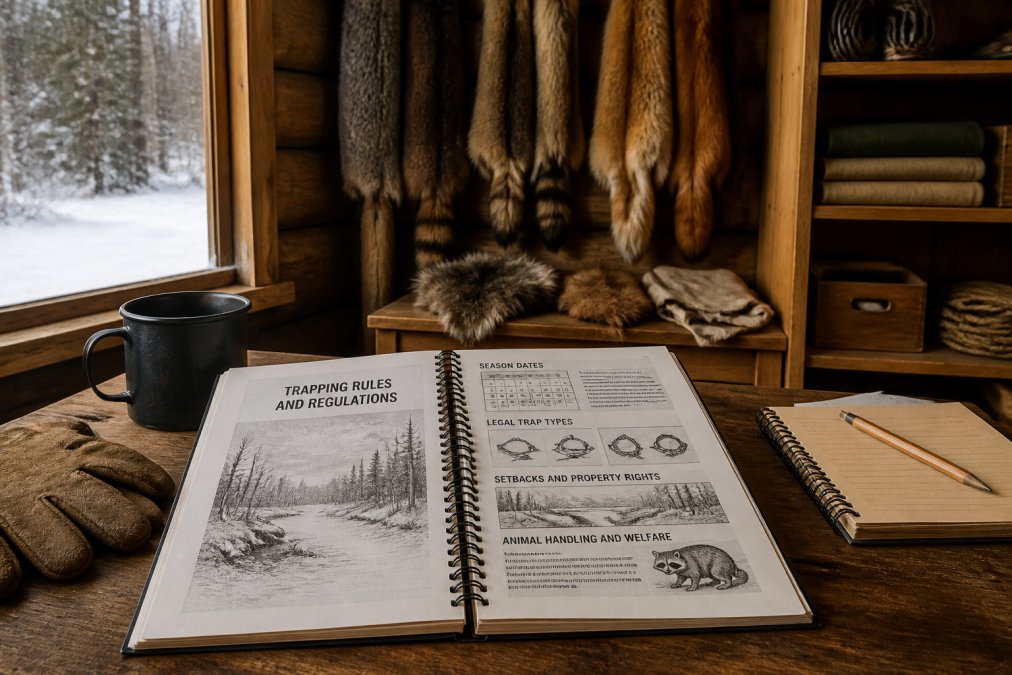
Infographic showing a trapper reviewing state trapping regulations alongside a map and notebook
Three variables cause the most trouble for newcomers:
- Season dates can shift yearly and sometimes mid-season by emergency order.
- Trap-type restrictions vary by species and by whether the set is on land or in water.
- Set-back distances from public trails, roads, and occupied dwellings differ sharply between states.
How to Read Any State's Rulebook in Four Passes
Work the guide in a fixed order so nothing gets skipped:
- Scope and license pass. Confirm the license or permit type you need, whether a furbearer endorsement is separate, and whether nonresident rules differ. Most guides open with this, and it is the easiest section to skim past.
- Season and limit pass. Write down the open and close dates and the daily and season limits for each species you intend to target. Note any species that requires a separate tag or lottery draw.
- Method pass. For each target species, record the permitted trap types, jaw or cable size restrictions, bait rules, and any prohibition on specific set styles. This is where land-versus-water distinctions usually appear.
- Placement and check pass. Record set-back distances, check intervals by set type, and any reporting or tagging requirement. These are the rules wardens verify most often in the field.
Build a one-page sheet per state you trap: species, season dates, limit, permitted trap, check interval, and reporting method. Rebuild it every season rather than editing last year's copy, because a changed date is easy to miss.
Where to Find Your State's Official Rules
Your state wildlife agency's website is the only authoritative source. Most publish a downloadable furbearer or trapping regulations guide each season, and many post emergency changes separately from the annual booklet. The U.S. Fish and Wildlife Service publishes federal context on furbearer management and migratory bird considerations that can affect water sets.
A practical verification checklist before every season:
- Download the current annual guide directly from the agency site, not a re-hosted copy.
- Check the agency's news or alert page for emergency orders issued after the guide was printed.
- Confirm the guide's effective date and whether it supersedes the prior year.
- If you use AI, make sure to verify the source information, AI has provided incorrect dates to many.
Why the Variation Exists
State agencies set rules against local population data, habitat, land-ownership patterns, and public input, so a rule that fits one state's landscape can be inappropriate in another. That is also why no single national rulebook exists for furbearer trapping: the Association of Fish and Wildlife Agencies coordinates among state agencies, but authority stays with the states. Treat every rulebook as jurisdiction-specific and every season as a fresh read.
Furbearer Trapping Seasons and Limits: Managing Sustainable Harvest
Furbearer trapping seasons and limits keep harvest within what a population can sustain.
Limits are not suggestions. Many states require harvest reporting, and unreported harvest undermines the data that sets next year's season, so report accurately even when the number is inconvenient.
A limit for one furbearer will not apply to another, and incidental capture rules differ by species. Know which species you are licensed to target and which you must release or report.
Ethical Trapping Practices: Beyond the Legal Minimum
Ethical trapping practices are voluntary standards above the legal minimum: checking sets more often than required, choosing trap types that reduce suffering, and avoiding sets where non-target capture is likely. Humane and ethical trapping are not the same as legal trapping, and the distinction matters for anyone selling pelts into a market that asks about sourcing.
Trap Selection and Placement for Humane Capture
Trap type and placement do most of the work. A well-placed set with the right trap reduces both suffering and bycatch. Body-gripping, submerged, and foothold traps each have appropriate and inappropriate applications, and state rules increasingly specify which is permitted where.
Placement decisions that reduce non-target capture:
- Set away from field edges and trails where pets and livestock travel.
- Use covered bait and enclosed sets where legal to limit access by non-target animals.
- Anchor and stake sets so captured animals cannot drag traps toward public access.
Trap Checking Requirements: Frequency, Timing, and Animal Removal
Trap checking requirements govern how often you must inspect sets and remove captured animals.
Daily trap checks are the standard ethical practice regardless of the legal minimum. Prompt removal protects the animal, the pelt, and you from a citation if a warden inspects your line.
What a proper check involves:
- Inspecting every set, not just the ones likely to have connected.
- Removing and dispatching captured animals humanely and per state requirements.
- Releasing non-target captures unharmed where possible and reporting as required.
The USDA Wildlife Services publishes guidance on humane dispatch and handling that is worth reading even where your state's rules are less detailed.
Avoiding Non-Target Captures: Protecting Pets and Livestock
Non-target capture, or bycatch, is the capture of a species you did not intend to take, including pets and farm animals. It shapes public opinion about trapping and is largely preventable through set selection and placement. The skill is knowing what you are likely to catch before you set, and what to do if the wrong animal is in the trap.
Identify the Likely Catch Before You Set
Selectivity starts with reading the ground. Before placing a set, answer three questions:
- What species sign is actually here? Track shape, scat, run orientation, and hair at a fence crossing tell you which furbearer is using the location. A set placed on the wrong sign invites the wrong animal.
- What else moves through this spot? Look for pet tracks, livestock trails, and human foot traffic. A set that is legal but sits on a path shared with dogs is a bycatch waiting to happen.
- What is the target's size and behavior? A trap sized for a raccoon will hold a much larger animal poorly and a much smaller one dangerously. Match trap size and jaw spread to the target, not to the largest animal you hope to see.
Set Choices That Reduce Bycatch
- Choose the right trap size for your target species. Oversized traps invite larger non-target captures.
- Use enclosed or submerged sets where legal, which physically exclude many non-target animals.
- Avoid bait that attracts pets and livestock. Animal matter bait should be covered and secured.
If a Non-Target Is Captured: A Step-by-Step Response
- Stop and assess from a distance. Identify the animal before approaching. A trapped dog, cat, or livestock animal may be agitated, and a stressed animal is more likely to injure itself or you.
- Protect yourself and the animal. Use a catch pole, shield, or heavy gloves where available. Do not put your hands near the trap jaws.
- Release humanely and lawfully. Release unharmed where possible using the release method your state allows. Some states require reporting of certain non-target captures; check your guide before you leave the site.
- Document the event. Record the species, set location, trap type, and time. If a pet or livestock animal is involved, contact the owner and your state wildlife agency as required.
- Adjust the set. A repeated non-target capture at the same location is a signal to move, not to try harder. Change trap size, switch to an enclosed set, or relocate entirely.
When to Walk Away
Some locations are not worth setting. Heavy pet traffic, curious livestock, or a public trail carries a bycatch risk no trap adjustment fully solves. The ethical choice, and often the legally safer one, is to leave it unset and find cleaner ground.
Common Misconceptions About Regulated Trapping
Misconceptions about regulated trapping cut both ways: some assume trapping is unregulated, others assume a single national rulebook applies. Neither is true.
- "Trapping is unregulated." Regulated trapping operates under state law with seasons, limits, trap restrictions, and reporting requirements, enforced by state wildlife officers.
- "One set of rules covers the whole country." State regulations differ substantially, and federal rules layer on top for certain species and situations.
- "Any trap is legal anywhere." Trap types are restricted by species, by land or water setting, and by state.
Conclusion
The hardest part of trapping compliance is not learning the rules once, but keeping up with them season after season, state after state, while documenting every set and check.
Ethically Fur connects trappers, hunters, and ethical fur sellers directly with crafters and taxidermists, offering wild-harvested and ethically farmed products, a transparent listing process, and a direct connection to North American sellers.
Frequently Asked Questions
Is fur trapping ethical?
Ethical trapping balances wildlife management with animal welfare. Regulated trapping follows state laws designed to maintain sustainable furbearer populations, and best practices like frequent trap checks and species-specific sets reduce suffering. Many trappers also support conservation through license fees and habitat work. The ethics depend on adherence to regulations, use of appropriate trap types, and respect for non-target animals. Ethically Fur connects buyers with sellers who prioritize these standards, offering transparency about sourcing.
What states have banned fur trapping?
A handful of states have restricted or banned certain trapping methods, but full bans on fur trapping are rare. Some states prohibit specific trap types like body-gripping traps on public land, while others have tightened regulations. Because rules change frequently, check your state wildlife agency's website for the most current information. Ethically Fur encourages trappers to stay informed and follow all applicable laws.
How can I find current fur trapping regulations and seasons?
Each state's fish and wildlife agency publishes an annual trapping guide with seasons, limits, and trap restrictions. Visit your agency's website or call their office for the latest PDF or printed copy. Regulations can change yearly, so verify before each season. For a state-by-state overview, see our guide above. Ethically Fur also recommends checking for any emergency rule changes that may occur mid-season.
What licenses or permits may be required to trap furbearers?
Most states require a trapping license, and some require additional permits for specific species or public lands. You may also need landowner permission on private property. Fees vary by state and residency status. Always carry your license while trapping and follow reporting requirements for certain species. Check with your state agency for exact requirements, as they differ widely.
What are common ethical practices for setting and checking traps?
Ethical trappers check traps daily or as required by law, use trap types that match target species, and place sets to avoid non-target captures. They also follow best practices for dispatching animals quickly and handling fur humanely. Avoiding bait that attracts pets and respecting landowner boundaries are part of responsible trapping. These practices go beyond legal minimums and support both animal welfare and public trust.
How do trapping regulations support wildlife conservation?
Regulations set seasons and limits based on population data, preventing overharvest and helping maintain healthy furbearer numbers. License fees fund conservation programs and habitat management. By following these rules, trappers contribute to sustainable wildlife management. Ethical trapping practices further reduce unintended harm to non-target species, supporting biodiversity.